
Visualize the LogicBehind the Code
From sorting and searching to more advanced data structures and algorithms, See Algorithms provides a hands-on approach to learning. Each animation is carefully crafted to walk you through the inner workings of various algorithms, step by step. Whether you're a student seeking to solidify your knowledge, an educator looking for dynamic teaching tools, or simply someone with a passion for computer science, you'll find value in our extensive library of visual resources. Explore our articles to deepen your understanding.
New Features: Elevate your learning with AI-powered insights, explore fearlessly with Undo / Redo, save custom setups to resume instantly, and embed interactive visualizers directly into your own website.
Visualization Preview
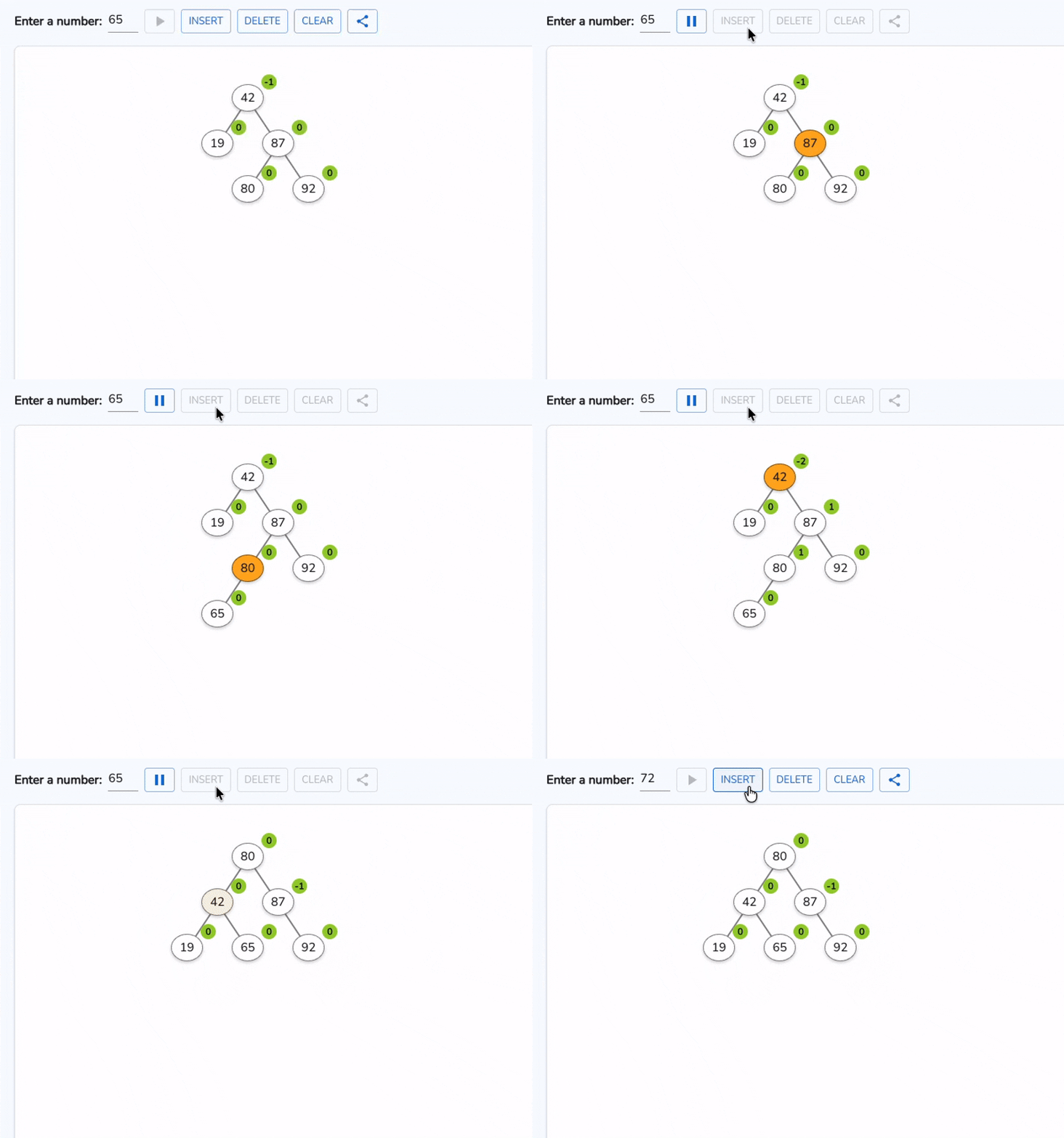
Use the controls to pause/resume animations, tweak inputs, or generate a shareable URL for the current graph or tree.
Algorithm Catalog
Browse all 30+ interactive visualizations. Search by name, category, or complexity to find the exact algorithm you need.
Bubble Sort
Repeatedly steps through the list, compares adjacent elements, and swaps them if they are in the wrong order.
Beginner
Launch VisualizerInsertion Sort
Builds a sorted array one element at a time by repeatedly taking the next item and inserting it into place.
Beginner
Launch VisualizerSelection Sort
Divides the array into sorted and unsorted regions, repeatedly finding and placing the smallest remaining item.
Beginner
Launch VisualizerHeap Sort
Converts the array into a binary heap, then systematically extracts the root element to build the sorted list.
Intermediate
Launch VisualizerMerge Sort
Recursively divides the array into halves, sorts each half, and merges the sorted sublists back together.
Intermediate
Launch VisualizerQuick Sort
Partitions elements around a chosen pivot, then recursively sorts the resulting smaller and larger partitions.
Intermediate
Launch VisualizerRadix Sort
Processes numbers digit by digit from least to most significant, sorting values without direct key comparisons.
Intermediate
Launch VisualizerDepth First Search
Traverses graphs by exploring as far as possible down each branch before backtracking to unvisited paths.
Beginner
Launch VisualizerBreadth First Search
Traverses graphs level by level, exploring every neighbor at the current depth before descending deeper.
Beginner
Launch VisualizerPrim's Algorithm
Grows a minimum spanning tree from a starting vertex by greedily adding the cheapest adjacent edge at each step.
Intermediate
Launch VisualizerKruskal's Algorithm
Builds a minimum spanning tree across the entire graph by connecting edges in increasing order of weight without cycles.
Intermediate
Launch VisualizerBorůvka's Algorithm
Constructs a minimum spanning tree by simultaneously selecting the cheapest outgoing edge from every connected component.
Advanced
Launch VisualizerDijkstra's Algorithm
Finds the shortest path from a starting vertex to all other nodes in a directed or undirected weighted graph.
Intermediate
Launch VisualizerTopological Sorting
Produces a linear ordering of vertices in a DAG such that every directed edge uv has vertex u appearing before v.
Intermediate
Launch VisualizerHamiltonian Cycle
Determines whether a graph contains a closed tour that visits every vertex exactly once and returns to the start.
Advanced
Launch VisualizerEulerian Cycle
Determines whether a graph contains a continuous trail that traverses every edge exactly once without repeating.
Advanced
Launch VisualizerLinked List
Stores data as a sequential chain of nodes where each element holds its value and a reference to the next node.
Beginner
Launch VisualizerDoubly Linked List
Maintains nodes with two-way references, enabling efficient forward and backward traversal through the list.
Beginner
Launch VisualizerCircular Queue
Organizes a FIFO buffer into a closed ring, reconnecting the tail back to the head for efficient fixed-size queuing.
Beginner
Launch VisualizerTrie (Prefix Tree)
An ordered tree that stores strings by sharing common prefixes, providing fast retrieval and auto-completion.
Intermediate
Launch VisualizerBinary Heap
A complete binary tree that maintains the heap order property for instant access to the minimum or maximum element.
Intermediate
Launch VisualizerBinary Search Tree
A binary tree where each left child is smaller and each right child is larger than their parent node.
Beginner
Launch VisualizerAVL Tree
A self-balancing binary search tree that maintains height differences of at most one via tree rotations.
Advanced
Launch VisualizerRed-Black Tree
A self-balancing search tree using node colors and restructuring rules to guarantee logarithmic search depth.
Advanced
Launch VisualizerSplay Tree
A self-adjusting search tree that splays recently accessed nodes to the root for optimized repeated queries.
Advanced
Launch VisualizerB-Tree
A balanced multi-way tree with broad branching, optimized for reading and writing large blocks of disk storage.
Advanced
Launch VisualizerB+ Tree
A B-tree variant with data exclusively in leaves linked in sequence, optimized for high-throughput range scans.
Advanced
Launch VisualizerConvex Hull
Finds the smallest convex polygon that completely encloses a given set of two-dimensional points.
Intermediate
Launch VisualizerHuffman Coding
Compresses data by assigning shorter bit sequences to frequent characters and longer codes to rarer ones.
Intermediate
Launch VisualizerSide-by-Side Comparison
See two algorithms run simultaneously on identical inputs to compare trade-offs:
Built for Deep Conceptual Understanding
Everything you need to experiment, analyze, and retain algorithm mechanics.
Visual Learning
Stop guessing what happens inside the loop. Our visualizer isolates and highlights the algorithm's exact decisions as they occur.
Playback Control
Don't just watch — control the flow. Pause, resume, and step through animations at your own pace to truly understand the algorithm's behavior.
Custom Inputs
Move beyond static examples. Draw custom directed or undirected graphs, edit weights, create binary trees, or input your own numbers to sort.
Share Insights
Created a tricky graph or a specific tree structure? Generate a unique URL to share your exact visualization setup with peers or students instantly.
AI Summary
Get AI-powered breakdowns of your custom graph algorithms and tree operations to bridge the gap between visualization and deep understanding.
Undo & Redo
Made a mistake? No problem. Seamlessly step backward and forward through your graph algorithm setup and rebalanced tree structure.
Save Data
Don't start from scratch. Save your custom graph layouts and complex data structures to your library to revisit and refine your experiments anytime.
Embed Visualizers
Seamlessly embed any of the interactive algorithm or data structure directly into your own website, blog, or educational materials.
Bridge the Gap Between Code and Concept
Textbooks and code editors can sometimes make logic feel abstract. SEE ALGORITHMS transforms complex logic into clear, step-by-step visualizations. Whether you are analyzing a directed graph or balancing a binary tree, our platform provides a focused, distraction-free environment to experiment and learn.
© 2025 See Algorithms. Code licensed under MIT, content under CC BY-NC 4.0